Built with Claude.
How I designed and shipped this portfolio using Claude as a creative collaborator, and what that process taught me about designing in the age of AI.
The problem
I needed a portfolio that felt like me, fast, without rebuilding everything in Figma.
What I did
Directed Claude through palette, typography, layout and copy; caught and corrected every fabricated detail; tested every layout across breakpoints.
Impact
A 10-page portfolio live in 10 active days, then audited and optimized with Claude Code: page weight cut from 10.8 MB to 0.9 MB.
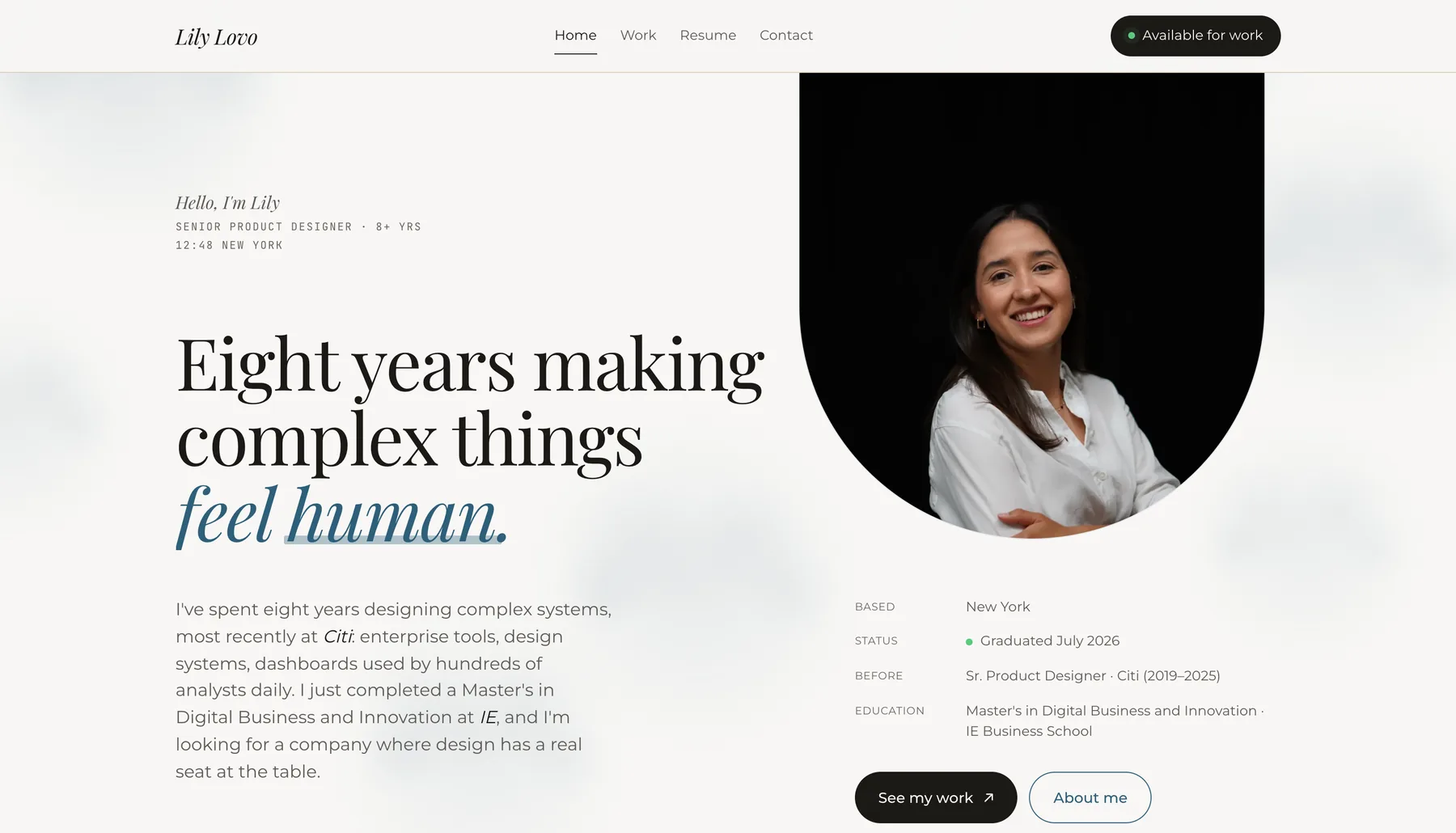
feel human.
The brief
A portfolio that proves the point.
I didn't set out to make a case study about AI. I set out to make a portfolio, one that showed my work honestly, felt like me, and looked like something I'd be proud to send to a design director at a company I actually wanted to work at.
I chose Claude for practical reasons: a clear vision, a tight timeline, and no time to rebuild everything in Figma. Claude Design was weeks old. I wanted to see how far I could push it.
The approach
I was the designer. Claude was the tool.
That distinction mattered from day one, and I had to enforce it constantly.
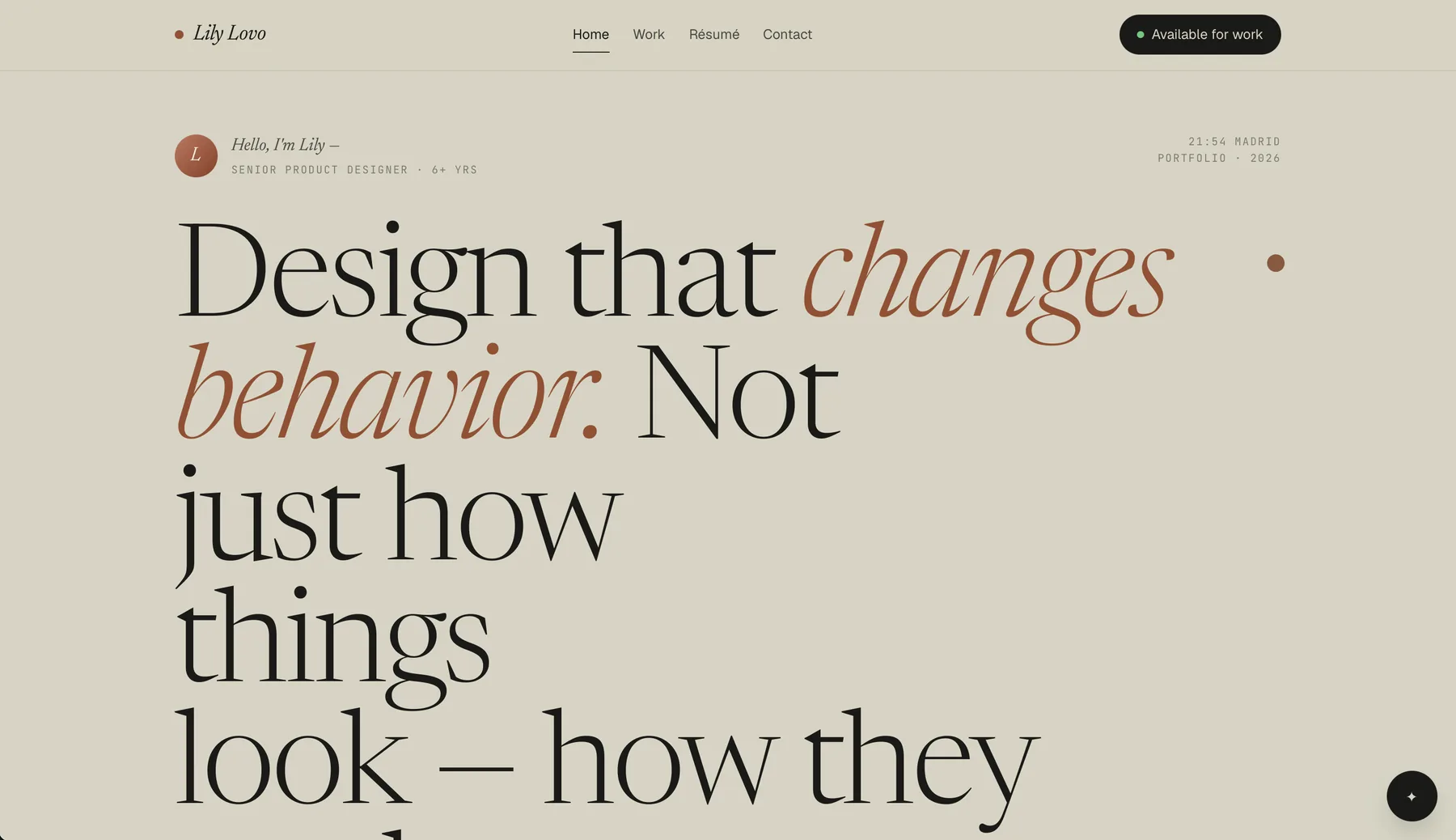
The direction was mine from the start. Quiet luxury editorial. The Pantone 2026 Color of the Year as the background. A deep slate blue as the only accent. Playfair Display for headlines. The structure and the stories came from my own work.
Claude's first attempt was competent and completely generic. A terracotta palette. Safe font choices. A layout that could have belonged to anyone. I pushed back, round after round, on palette, typography, and layout until it matched what I had in my head.
Years of enterprise work gave me fluency in front-end thinking. I can read HTML and CSS, understand what z-index means, and spot when a border-radius is wrong before I even open the browser. That technical literacy changed the quality of my prompts entirely. Instead of saying "the photo doesn't look right," I could say "the object-position needs to shift to center 10% and the container needs overflow: hidden."
The first drafts of my case studies were full of fabrications: invented metrics, quotes from colleagues that never happened, wrong place names, real employee names in dashboard screenshots. Catching and correcting those details required going back to my original work, my CV, my actual memory. The AI made it faster to generate. I made it true.
My portrait took more than ten prompts: editorial treatment, photo bleeding from the nav, an arch-shaped bottom. Claude kept defaulting to simpler solutions, and each time I pushed back with a reference image or a specific CSS fix. The gap between "Claude understood what I wanted" and "Claude produced what I wanted" was where the design work happened.
The shift
From prompt to judgment.
The most useful mental model I developed: Claude handles execution; I handle judgment.
Execution is where Claude is fast and tireless: writing CSS for a two-column grid, applying color values across every HTML file, generating layout variations. I stopped thinking of that as "AI doing my job" and started thinking of it as working with a fast, patient engineer.
Judgment is everything else. Does this feel like me? Is this true? Is this the right word? Does this case study sound like something I actually believe, or does it sound like something a designer would post on LinkedIn?
Those questions can't be prompted away. They're about my work, my story, my taste.
The outcome
A full portfolio. 10 active days.
lilianalovo.com is live, in my direction and in my voice.
Launch wasn't the end. After going live, I used Claude Code to audit the site the way I'd audit a product: I cut page weight from 10.8 MB to 0.9 MB, fixed text contrast to meet WCAG AA, and set up a clean deploy and version history. Then I ran a recruiter's review and a copywriter's review, and applied both line by line.
The output is only as good as the judgment you bring to it. Claude made me faster. It didn't make me a better designer; that part was still mine.
The designers who will thrive with these tools are not the ones who prompt the best. They are the ones who can tell the difference between a good result and a convincing one.
What I took with me
The AI was the brush. I was still the painter.
Building this portfolio sharpened my instincts in ways I didn't expect. Every decision was mine: the color, the copy, the layout, the responsive behavior. There was no brief to hide behind and no stakeholder to defer to. That kind of ownership clarifies what you believe about design.