Leadership Intelligence Dashboard.
A health-pulse dashboard that gave Citi's senior leadership one clear view of risk and controls compliance, shipped under deadline.
The problem
Senior leadership tracked risk and controls compliance through manually compiled spreadsheets and decks.
What I did
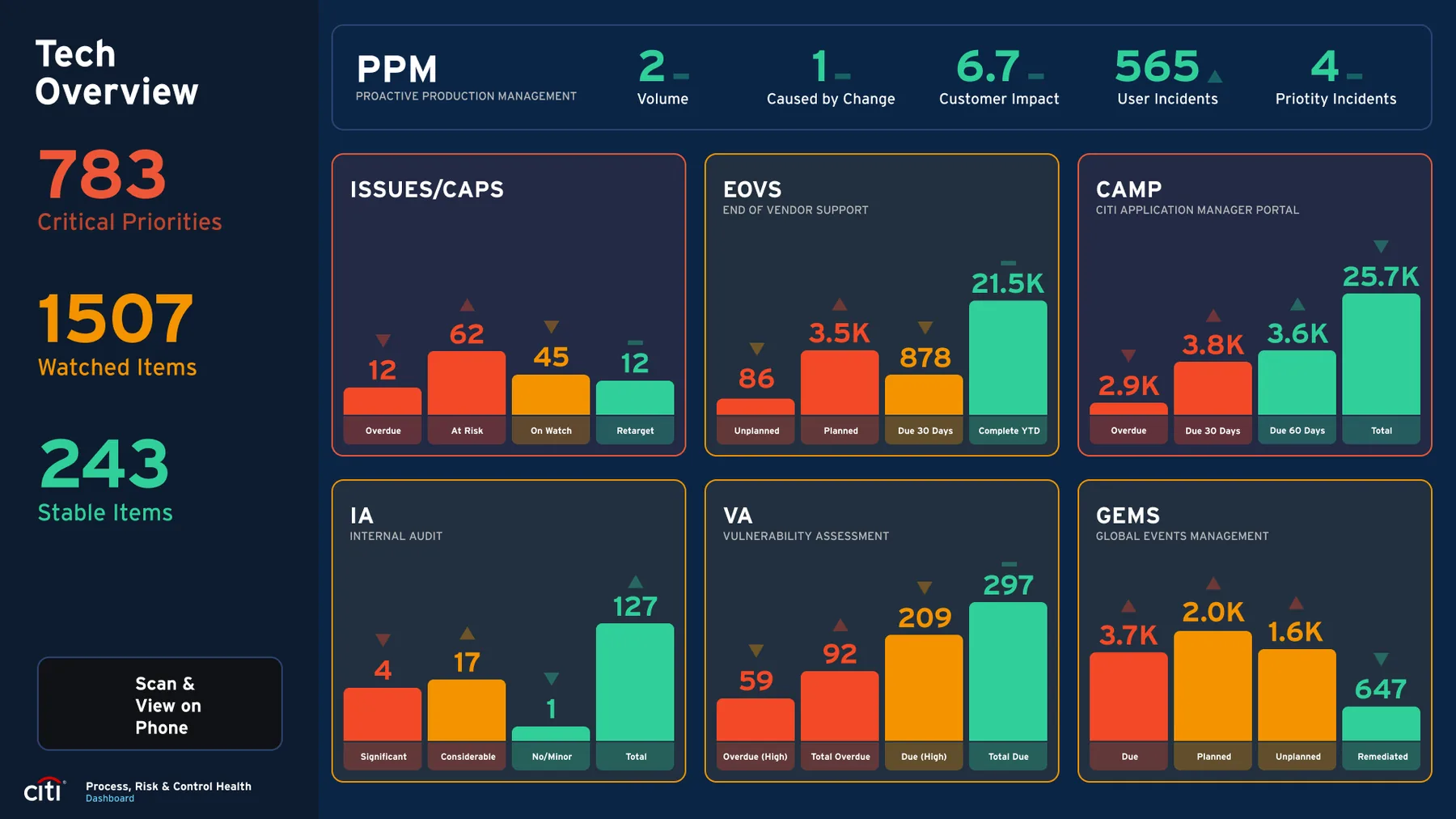
Led design under a 2–3 month deadline: rapid stakeholder sessions, parallel concepts, a summary-first hierarchy, and high-fidelity prototypes for leadership review.
Impact
Shipped on time and adopted as the primary tool for risk reviews, replacing manually compiled reports for most teams.
source of truth.
| Priority | Issue ID | Issue Name | Owner | CAP Owner | Due | Source | Status |
|---|---|---|---|---|---|---|---|
| High | ISS-001 | Access review backlog | Team A | Team A | Q2 24 | Audit | Overdue |
| High | ISS-014 | Control mapping gap | Team B | Team B | 30 d | Self-ID | In Progress |
| High | ISS-019 | Segregation of duties | Owner | Team C | 30 d | Audit | In Progress |
| Medium | ISS-022 | Vendor risk refresh | Owner | Team A | Q3 24 | Review | On Track |
| Medium | CAP-042 | Policy exception review | Team C | Team C | 45 d | Self-ID | In Progress |
| Medium | ISS-028 | Evidence completeness | Team B | Team B | Q3 24 | Audit | On Track |
| Low | ISS-037 | Evidence collection | Team A | Team A | Q3 24 | Review | On Track |
| Low | CAP-051 | Remediation sign-off | Owner | Team C | 60 d | Self-ID | On Track |
| Metric | MTD | Target | Var | YTD | St |
|---|---|---|---|---|---|
| Throughput | 1,284 | 1,300 | −16 | 14,802 | |
| Cycle time | 4.2 | 4.0 | +0.2 | 4.1 | |
| Defect rate | 1.8% | 2.0% | −0.2 | 1.9% | |
| Capacity | 92% | 90% | +2 | 91% | |
| SLA met | 96% | 95% | +1 | 95% | |
| Rework | 3.1% | 3.0% | +0.1 | 3.2% |
| Category | Low | Med | High | Crit | Total | %Δ |
|---|---|---|---|---|---|---|
| Network | 12 | 6 | 2 | 0 | 20 | +4% |
| Endpoint | 8 | 4 | 1 | 0 | 13 | −2% |
| Identity | 5 | 3 | 0 | 0 | 8 | +1% |
| Cloud | 9 | 5 | 3 | 1 | 18 | +9% |
| Application | 7 | 4 | 2 | 0 | 13 | +3% |
| Severity | MTD | Prev | Target | Var |
|---|---|---|---|---|
| Sev 1 | 2 | 1 | 0 | +2 |
| Sev 2 | 6 | 5 | 5 | +1 |
| Sev 3 | 14 | 16 | 15 | −1 |
| Total | 22 | 22 | 20 | +2 |
| Region | Active | New | Closed | Aging | % Overdue |
|---|---|---|---|---|---|
| Region 1 | 18 | 4 | 11 | 9 d | 12% |
| Region 2 | 24 | 6 | 9 | 14 d | 18% |
| Region 3 | 15 | 3 | 14 | 6 d | 8% |
| Region 4 | 20 | 5 | 12 | 11 d | 15% |
| Total | 77 | 18 | 46 | 10 d | 13% |
| Measure | Actual | Target | Gap | Progress |
|---|---|---|---|---|
| Issue closure | 84% | 90% | −6 | |
| Control coverage | 91% | 95% | −4 | |
| Evidence rate | 78% | 85% | −7 | |
| On-time rate | 88% | 90% | −2 |
The brief
A pulse check, under deadline.
Senior leadership needed a fast read on how their domain was performing on risk and controls compliance: a health pulse they could act on. Internally it was called PRC (Process, Risk & Control) Health, and it was high priority.
The real challenge wasn't the data. It was the timeline. The tool had to ship fast, meet the high standards of senior stakeholders, and still feel calm enough that an MD could read it in two minutes between meetings.
A dashboard that shows your own program's health to your own leadership team is inherently sensitive. Data that's good news is easy. Data that shows problems requires careful thought about how it's framed and surfaced. The design had to be honest without being alarmist.
The research
Fast research, clear priorities.
With the clock ticking, I engaged stakeholders immediately to gather context: what mattered most, what "good" looked like to leadership, and where the existing reporting was failing them. There wasn't time for a long discovery phase: discovery had to happen alongside the design.
I ran rapid ideation in parallel: multiple concepts explored quickly to test different ways of expressing program health, then put in front of stakeholders within days, not weeks. The bar was deliberately low for fidelity and high for speed of feedback.
The goal underneath all of it was clear: give leadership a view of risk and controls compliance they could read at a glance.
The shift
From data to decisions.
Early wireframes and low-fidelity prototypes reached stakeholders in the first weeks. Their feedback was integrated immediately into the next round, with constant communication so no one was surprised by the direction. When something didn't work, we cut it the same day.
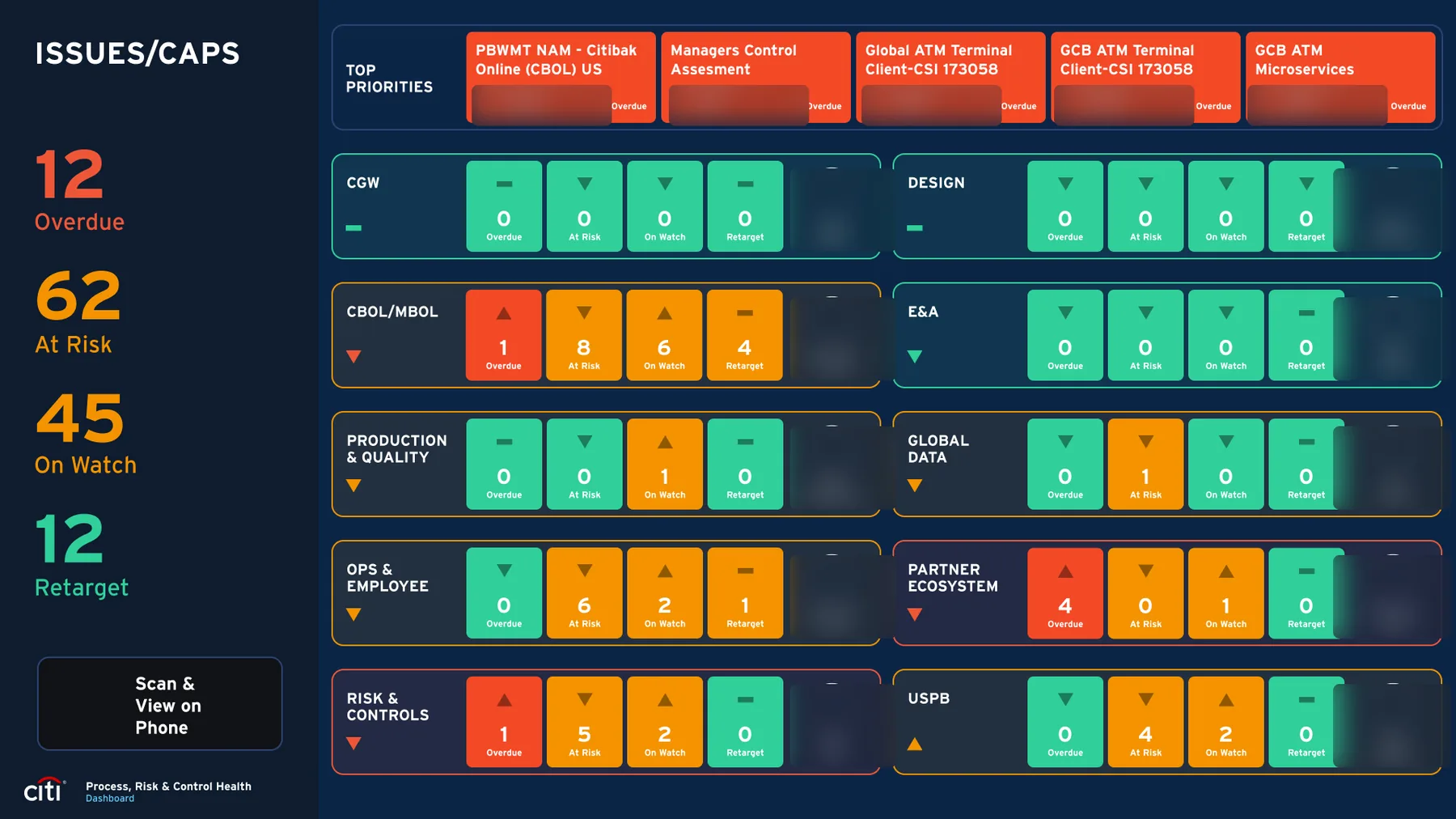
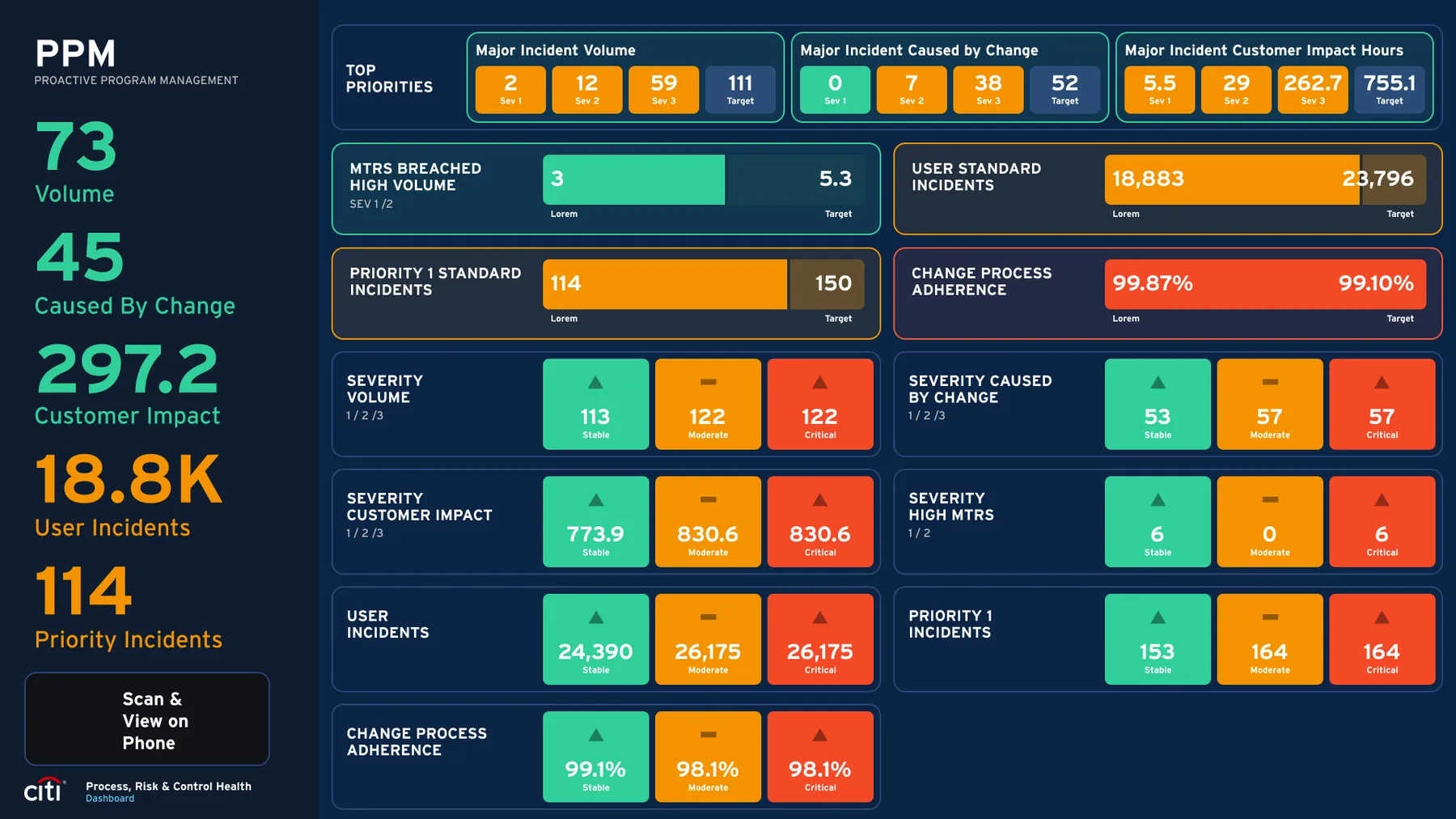
The core design decision was hierarchy. Everything in the interface was organized around what leadership needed to know first, program health at a glance, with trend context always visible alongside point-in-time numbers, and deeper data available on demand with one click. The front door was always a summary, never a chart wall.
The final round was high-fidelity prototypes for senior leadership review. The polish lived at the end of the process, not the start, which is the only way design under deadline stays honest.
The outcome
Shipped on time, used by leadership.
The dashboard shipped within the tight timeframe leadership had set. By the next review cycle, most teams had stopped compiling reports by hand: the dashboard told the same story faster, with the underlying data one click away.
Conversations changed too. Instead of reviewing what had happened last month, leadership talked about what was happening now, and could track compliance issues in flight rather than after the fact.
What I took with me
Adaptability is a design skill.
This project taught me that adaptability is a design skill, not just a personality trait. When the timeline is tight and the audience is senior leadership, the ability to move fast, communicate clearly, and make the right call without perfect information is as important as what you put on the screen.
I also learned that designing for executives is harder than it looks, not because the design problems are more complex, but because access is limited. Most of my research on this project was done with delegates rather than the executives themselves. There is a version of this dashboard that has been truly validated against the people reading it every morning, and that version would probably look different in important ways. That is the honest next step.